Showing posts with label MOTAT. Show all posts

Monday, February 8, 2016

First Week of February

This is a significant week for the population of the country and has a day with special significance for Auckland.

Firstly, it is a week when parents across the nation shout our ‘Hooray, their going back’. Schools begin to open after the long summer holiday. For our family this means the start of the new school year on Wednesday.

Secondly, in Auckland, the return to school is delayed by one day as the people of Auckland celebrate ‘Auckland Day’. For us this meant a family trip to Mission Bay market. This is an event when craft traders set up their stalls on the grass at Mission Bay. We woke to pouring rain, but by 10.00 am the grass at the event was bone dry and trade went on in earnest. There was a great range of high quality goods. Irene and I had a good conversation with an artist who inspired us. We all had lunch at the ‘Mission Bay Café’. 
In the afternoon I continued my building of the ‘Millennium Falcon’.

On Tuesday we had a car and made a one hour journey to the Hunua Falls. This is on the edge of the Hunua Reserve which is a large area of forested hills and reservoirs. I made sure not only to sun-up, but also to put on insect repellent. We arrived at a good car park with toilet and could, immediately hear the sound of the rushing water. There was much photographing as we approached closer to the rushing water. We were pleased that we had arrived early as a group of young people arrived as we were leaving. Their goal was frolic about in the icy cold mountain water. We did a brief walk up to a lookout. At place on that walk the sound of the cicadas was almost deafening. They are small bugs, but they make a loud noise.


Next we thought that we would try to find the Wairoa reservoir. This meant driving out of the reserve and around it to go back in. Our journey meant going through the village of Hunua. (Hunua is a small settlement in the rural outskirts of south Auckland, New Zealand. The Hunua Statistical area, which covers a much larger area than the settlement, had a population of 4242 people.) We found two trading places. First was the garage and second was a building which housed the booze shop, the general store, the fish and chip shop and the Indian restaurant. The owner of the property seemed to be Sikh. At his shop we indulged in nice cold drink.

The Wairoa reservoir was less-tourist friendly. There was no car park close by so we parked on the grass outside the gates. From here it was a five minute walk to the toilet. There were many walks around for the fit, but we chose to keep to the road way up to the dam. Reservoirs are special places and this was no exception. However, unlike the ones we know in the UK this was very peaceful and we were the only people there.

From there we headed to Maraetai. I remembered this as a beautiful seaside resort and it did not disappoint. We pulled up at the first café and we were served by a young lady who was recent arrival from the Liverpool area. After 6 months people are ribbing her about her accent. The beach is shelly and the sea is calm and beautifully clear.
I was just puzzling as to why we had a car on Tuesday and Wednesday. Irene reminded me that Sally was at home. On each day she was at home having planning meetings with her team.


On Wednesday the girls began their new school year. They went off happily. 

It was not possible for us to go off too far today so we headed for Cockle Bay. I had thought that it would be something like Maraetai. It was calm. However, it was more like Morecombe Bay, but we were not allowed to collect live cockles. Apart from a toilet and seats there were no other facilities. Shells were abundant on the beach. It was interesting to see mums and toddlers in the park now that the older children were not around. Next we drove off to Howick Beach. Again this had no resources and fewer cockles.
On the way back we stopped at Pakuranga shopping centre. I can’t remember what for, but we had refreshments at ‘Muffin Break’. Next we stopped at ‘New World’ for shopping and finally at the Pharmacy in St Heliers for medicines.

We took Emily to school on Wednesday morning and they were mainly at home apart from going to do some shopping at St Heliers. It was not so pleasant near the beach so we had coffee in the arcade. It was a bit special. 

We visited ‘Take Note’ which is my favourite shop. It is a book shop and stationer. We had already spotted trouble ahead for the post office here. A notice in ‘Take Note’ confirmed that a post office counter was going to be put inside. We also saw on the notice an appeal that the staff should not be abused. Next we met two ladies near the library with their ‘Keep the Post Office’ petition. I commented on the notice in ‘Take Note’. They were incensed about the fact that the staff was being abused. NZ is now going the same way as the UK with their post office services.

It was a wet day on Friday. We did try to go for a walk. Finally we decided to add some distance to our walk to collect the girls. Irene did have umbrellas. At first the rain was light and dried as soon as it fell. But at 3.00 pm precisely the heavens opened. Fortunately Sally came home early and spotted us and we piled into the car.

Saturday began with rain but we were able to walk down to St Heliers. Here we had coffee and pie at the bakers.

There was a decision to go to MOTAT on Sunday. Emily decided not to and stated behind. So Sally, Mum, Zoe and I went. This weekend is Waitangi weekend and the road off to the zoo and MOTAT was busy. There was a vintage car swap meet next to MOTAT but we managed to park in the last space.

For a change we went into ‘Western Springs’ park. There were a lot of water birds. Zoe climbed a tree. Irene spotted Puketo chicks. We had never seen these before.
 Zoe enjoyed trying out the experiments. 


We had lunch in the café. The building that housed it was built towards the end of the 19th century. At the beginning of the next century it was moved and in 1975 it was moved to the place it now stands. It is not a little building. We visited the model railway.

When we went for the horse and carriage ride it was resting for lunch. We went to the historic village and had a chat with the lady sitting knitting outside the house. Then went to the blacksmith and I recognised him and he is the same fun character as he was two years ago.

 On the way back we went back into the park. This time we were armed with bird food and soon attracted a good sized flock. The visited ended as Zoe got stuck in the tree and sustained some painfully injury. Sally got her home and she was fine by morning.

Sunday, February 9, 2014

Third Week

Monday was the last day of the school holidays and it was a glorious day. Zoe had had a sleep over with her friend, Jadey. During the morning Irene, Sally, Emily and I made our way down to the beach at St Heliers and there we met up with Zoe and her friends. Emily enjoyed a good dip in the sea. The sea had gone from being a long way out to being unusually far in. We had experienced a 'King tide'. This meant that the sand and gravel had been moved higher up to the shore and the sea level was dramatically deeper.

Once all the girls were together, the main activity seemed to be to bury one another. It was hard to believe that being buried could be so much fun.


At lunch time the group broke up and we returned home for lunch. Both girls had got a play date booked with their friends and so Irene and I concluded that being somewhere else would be a good thing. We borrowed the car and made a trip to a coastal resort known as Maraetai which was some 45 minutes away and took us out of Auckland.
Maraetai
Waiheke island is close at this point
Rangitoto Island from a different angle

It is quite a pretty place and the beach is sheltered by Waiheke island. It has a short pier which was used to load cattle on to boats to be shipped to Auckland. We walked a little way along the shore before going back to the car. We decided to drive further on round a hill. We then continued to the slightly larger township of Clevedon before swinging back to Whitford and home.

Before going home we stopped off at Pakuranga shopping mall. In the food court we found a kiosk selling Indian food. The rice was very light and the curry very tasty. We could not complain about the value at £5 each.

In the evening we sat and watched 'Master Chef'. I must say that I liked the appearance of the 'Black Forest' cakes. The main ingredient seemed to be chocolate flakes making a wall which contained cherries on stalks. Here is a challenge for someone to make for me when I return. We finished the evening watching a different series of 'Person of Interest'. Incidentally, we also watched a programme in the series called 'Elementary'. This is an American version of 'Sherlock'. However, the English accent is overdone. Even the cockneys were Oxford graduates.

Tuesday was the start of school term in St Heliers. We had the privilege of escorting the girls to their rooms. The first order of the day was buying a sun hat for Emily from one of the volunteers manning the stall.

I went into Zoe's classroom on the first floor. The place seemed calm and well organised.

The second task of the day was shopping for household goods. We successfully purchased a cutlery tray, baking trays and pillows.

This left us with time to go off somewhere. I chose to go off to Maurawi on the west coast. Coffee there was good even if it was very slow in coming. The cake slice was delicious. After this we drove to the gannet colony and observed them from the various vantage points.


Then we drove down to the beach. It is typical of the east coast. The wind drives high waves on to the beach and then blows the crests of the waves off, creating a mist all along the shore.


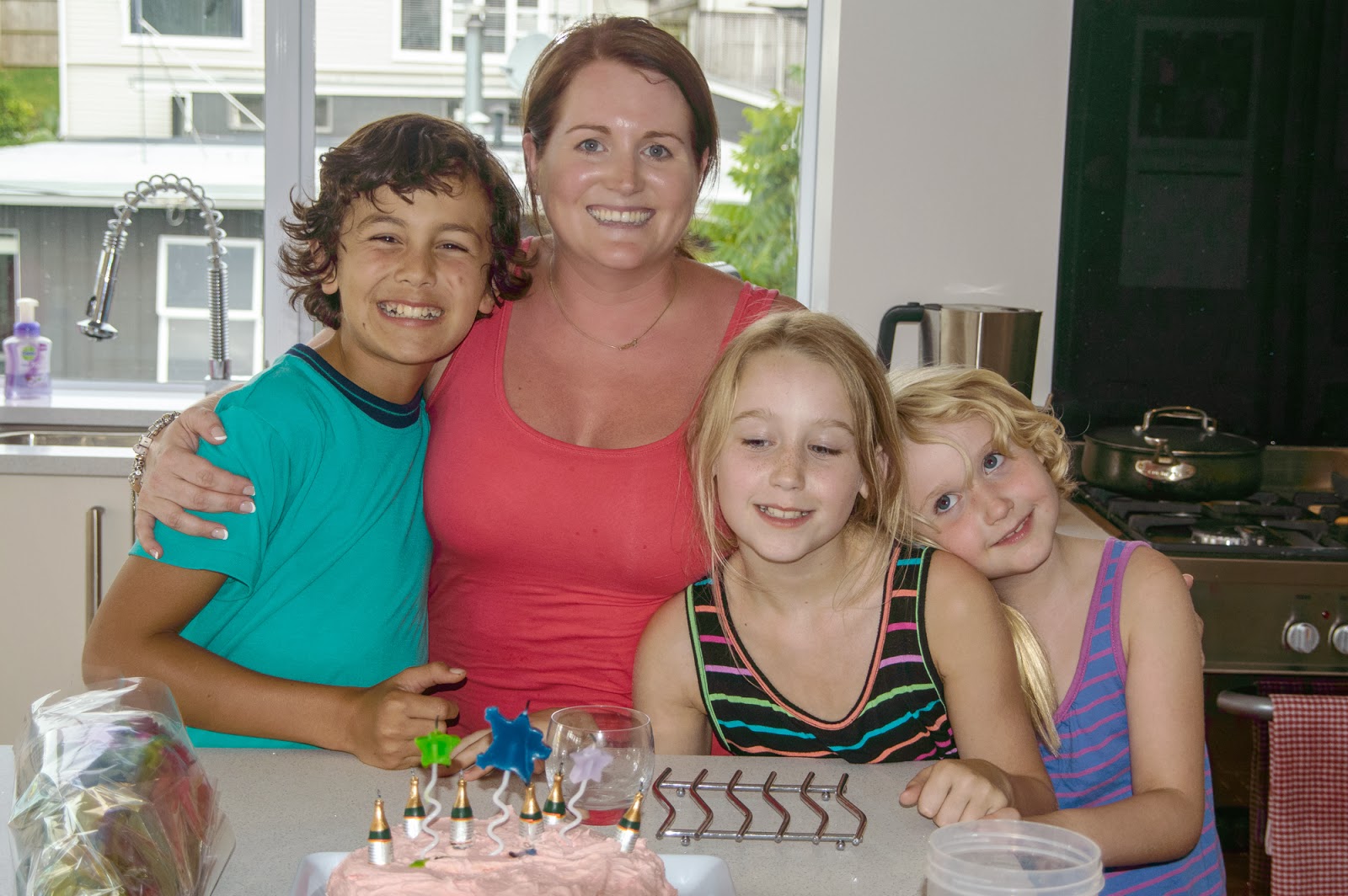
Before tea there was the blowing out of birthday candles for Sally's friend and child minder.


On Wednesday Irene and I spent the morning in and in the afternoon walked down to St Heliers. As we left the house the wind got up and it got cooler. Our first stop was the doctors' surgery to pick up prescriptions for Sally and Zoe. These were repeat prescriptions, but still cost us £16.50 to collect + the cost at the pharmacy. We then went to the post office to buy stamps for letters that Sally was sending to the UK.

In the evening Ian sorted out the flight and car for our trip to the Canterbury region of South Island. I had given up the effort. On my attempt to get prices we could have got full board for eight days in Phuket.

We tried sitting reading on the sea front, but it was too cold. So, after purchasing strawberries and other things we sat reading in the library before returning home.

The girls have been back at school two days and Sally at work for one, but today is Waitangi Day and it is a bank holiday. Waitangi day is normally celebrated by shopping and throwing stuff at MPs. Ian took Zoe and I to the zoo. Despite the fact that the vast car parks were full, the zoo was far from crowded and a good opportunity to do some photography.


Not a puppy

Zoe sticking her head into the meerkat enclosure
 After lunch we joined the main throng in the shopping centre where I bought more pants. For some reason one pair a day is not enough.

On Friday we were in for most of the day. Somewhat unexpectedly the electrician arrived. Irene and I planned the day for booking our south island itinerary and accommodation. Eventually some power was restored. I was keen that we had electricity to the wi-fi and the television. However, he did not restore power for cooking or hot water. Our evening meal was fish and chips from the local shops.

The electrician arrived the following morning and so did a friend of the family called Ian. His main job was to do flashings and plasterboard up some holes. By the end of the morning there was an opportunity for Irene and I to drive out for the weekly shopping. It was a long shop and not long after we got back the family friends arrived. The friends included three children and the five of them kept themselves entertained. The barbecue was used and the kebabs that we had bought earlier were cooked and the meal was finished off with a pavlova and a very tasty plum in sponge pie soaked in a sweet plum sauce. The plum feast was courtesy of Sally's friend.

After the friends had departed it was then that we discovered that Benny cat had disappeared. As we watched television there was the sound of a cat crying. Benny had done his trick of taking the opportunity to get below the house. However, a hole had been bricked in and the access from a cupboard had been closed off. Sally opened the access door to a relieved, but quite shocked cat.

Our Saturday activity began with breakfast at 'Coffee Club' where Zoe and I had a pancake pile each. This was topped off with ice-cream, cream and maple syrup. Satisfied, we drove off to MOTAT (Museum of Transport and Technology).
The first stop was in the dome where there was a lot of hands-on stuff.
I found myself in a kaleidoscope where I was confronted with numerous images of myself.
Zoe found her way to the print shop where she type set her name and made numerous prints
There was an exhibition showing Edmund Hillary in his famous trek to the South Pole. In the picture is one of the tractors which towed materials to the pole. It is basically a farm tractor with an additional set of wheels and a makeshift track over them. Apparently, it performed well.  There is a thing called 'Kiwi Know How'. They don't do pretty, but they do do functional.
Zoe's favourite activity was the dark maze. It is what it says it is. On our travels she enjoyed fiddling in a cut up car. In the same exhibition about New Zealander's love for cars there was also a salutary warning to would be joy riders. On one wall was a flattened car. Two months after we left in 2012 the consequence of street racing was to have your car flattened. For some reason the street racer is removed from the car before it is flattened.
There was a major exhibition on search and rescue. A Zoe favourite was swimming in the ball sea.

Another thing which kept her amused was the studio. The green screen was used to blend the image of a fire scene with the presenter and there were buttons to switch between the studio and the reporter.


The idea of the whisper dish was just that. Eventually they were used so that conversations could not be carried across the whole of MOTAT.

As you will see on Sally's Facebook page I made the mistake of taking Zoe on at chess. She is a worthy opponent. She knows the rules and thinks about her play. I make no excuses. Having regained my queen I might well have pursued her around the board for some time. We bought the game to an end.
For some reason, probably the car, trams came out of use all across the world at the same time.

In the village area Zoe came across the stocks. She did not like the idea that the locals might throw rotten things at you to add to the punishment.

Various volunteers were on hand. The man below is a blacksmith. He had done work as a farrier. He did not like the fact that owners sometimes cut corners and had less that adequate shoes fitted to their horses.


Irene spent a lot of time speaking to a lady who sat outside the cottage. She was doing some amazingly intricate lace making. There was also talk about the differences in gardening between the UK and NZ.

Our visit ended with a carriage ride around the MOTAT grounds.

A note about fencibles from Wikipedia. We saw some 'fencible' homes in the village.
The term 'fencible is derived from defensible, and regiments had been raised during the 1770s (for the Seven Years' War and the American War of Independence) and the 1790s (for the French Revolutionary and Napoleonic Wars) — see list of British fencible regiments. Unlike regular British line regiments which could be posted anywhere, fencible regiments were raised for local defence and garrison duties and usually under their conditions for enlistment the men of a fencible corps could not be posted to other theatres.[2]
The conditions for enlistment in the New Zealand Fencible were that soldiers of good character must have had 15 years of military service and have been under 48 years of age. Nearly all those recruited had extensive military action in India and Afghanistan. Most were married with several children. The conditions were posted at regiments throughout the British Isles.[citation needed]
Pay was 6 pence to 1 shilling and 3 pence a day in addition to their pension. The Commandant (Major Kenny) was paid £300; each officer was given a house and 50 acres (20 ha) of land[3] The pensioners were to be provided with a prefabricated fencibles cottage of 2 rooms, on an acre of land. One of the few remaining cottages, albeit in an altered form, is on its original site at 34 Abercrombie St, Howick. This cottage was built with the help of Maori labour for Henry and Elizabeth Rowe and their surviving 3 children in 1848, after they arrived in the Sir George Seymour in November 1847 . After 7 years the cottage and land would become their own property in exchange for the pensioner attending military exercises 12 days a year.[citation needed]
Ten ships brought 721 pensioner soldiers and their families, totalling over 2,500 people, between the years 1847 and 1852. The ships were Ann, Berhampore, Berwick Castle, Clifton, Inchannan, Minerva, Sir George Seymour and Sir Robert Sale.[4] The average age of the men was about 40. They settled in the Auckland suburbs of HowickOnehungaOtahuhu and Panmure.[5] At Howick a redoubt was built on Stockade Hill, a prominent hill at the north end of the village's main street. The position, with its associated earth works, is still there. In the 1849 census one third of Auckland's population were fencibles.[6] About half were Anglican and half Catholic. Apart from working on their own plots most men were engaged in building roads between the fencible settlements. The material used for road building was scoria from volcanic cones at Pidgeon Mountain(then called Pidgeon Tree Hill),Mt Richmond and Mt Wellington.[7]
They were first called to action in 1851 when a large party of about 350–450 Ngati Paoa from the Thames and Waikehe Island areas arrived at Mechanics Bay Auckland in about 20 waka to attack the city. A British regiment at Albert Park Barracks was called out to the hill overlooking the bay. It was reinforced by fencibles who had come from Onehunga, the closest fencible town. Fencibles at Howick and Panmure were stood to in case of further trouble. The frigate HMS Fly trained its guns on the Maori war party from offshore. The cause of the aggression was the arrest of a Ngati Paoa Chief who had stolen a shift from a shop in Shortland St. The situation was defused when the attackers were given tobacco and blankets. Later Ngati Paoa sent a greenstone mere (club) to the governor.[8]
A group of 121 Ngati Mahuta under the great Waikato chief Te Wherowhero were also bought to South Auckland to defend the capital. They were given land at Mangere in 1849. They supplied their own arms but had British officers.[9]
During the 1863 war about 75 military pensioners and their sons served in the Auckland Militia to defend Auckland.[10]